
Oregon Rent Increase Limits: What Multifamily Owners Need to Know

Oregon has released its maximum allowable rent increase for 2027, bringing the statewide limit back to 10% for residential tenancies subject to Oregon’s rent-stabilization law. The 2026 limit was 9.5%. Oregon calculates the annual maximum as the lesser of 10% or 7% plus the applicable Consumer Price Index. Oregon
For apartment owners, however, the headline number only tells part of the story.
The more important question is whether market conditions actually support rent growth anywhere near the statutory ceiling — and how the relationship between rents, expenses, occupancy and regulation affects property value.
Oregon’s 2027 Rent Increase Limit
For 2027, Oregon’s Department of Administrative Services established the maximum allowable annual rent increase at 10% for tenancies subject to the applicable residential rent-stabilization statute. That compares with a 9.5% maximum for 2026 and 10% for 2025. Oregon
That does not mean owners should expect rents to increase by 10%.
The statutory maximum establishes a ceiling. The market determines what rent growth is actually achievable.
That distinction is increasingly important for underwriting.
An owner may technically have room to increase rents under state law while still operating in a market where comparable properties, concessions, vacancy or tenant affordability constrain achievable increases to a much lower level.
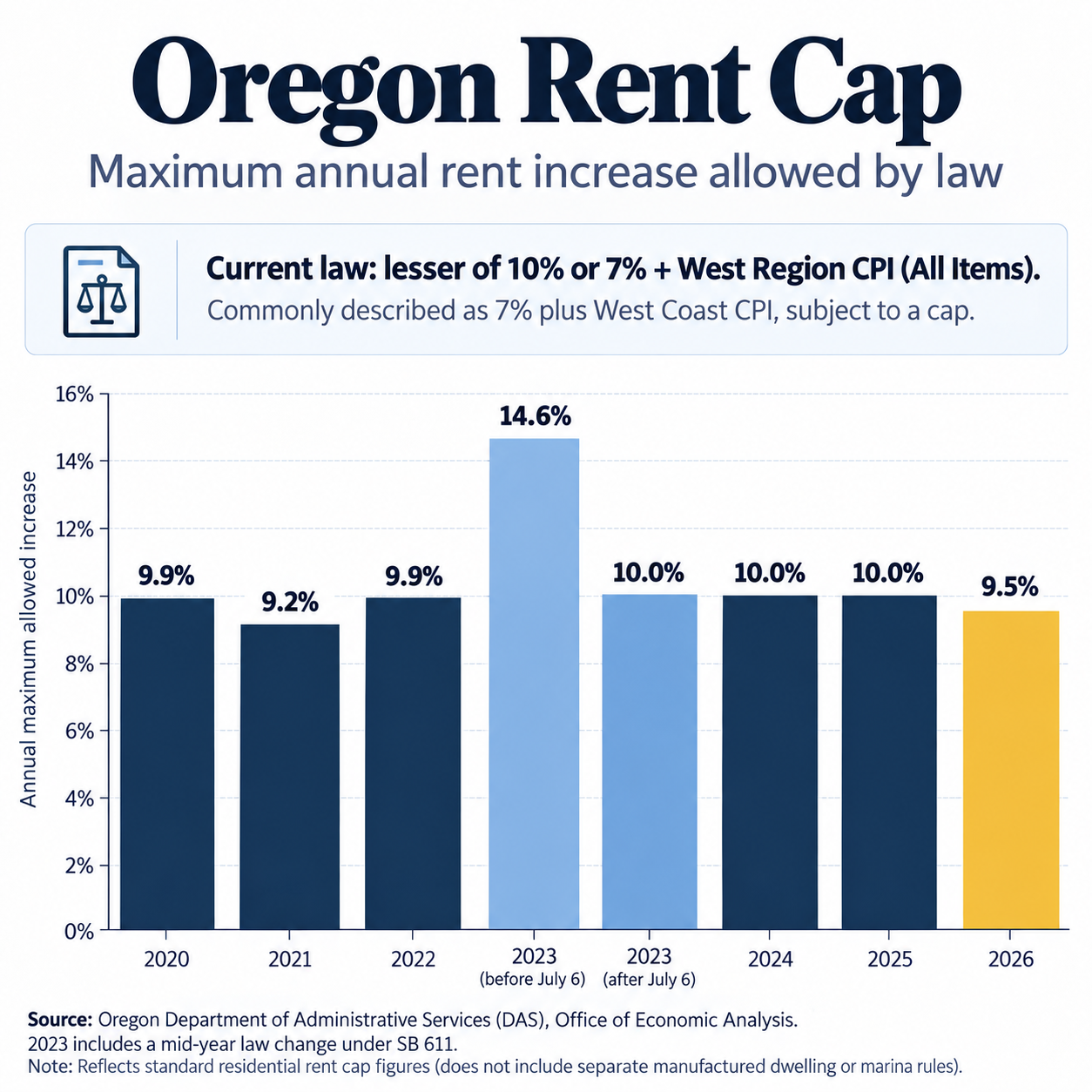
Oregon’s annual rent cap has generally remained near 9–10%, with a mid-year statutory change in 2023 introducing the 10% ceiling.
The Rent Cap and Market Rent Growth Are Two Different Things
Much of the discussion surrounding rent regulation focuses on how high the statutory limit is.
From an investment perspective, I believe the more useful question is:
How does the allowable increase compare with actual market rent growth?
In many Pacific Northwest submarkets, recent rent growth has been considerably more modest than the regulatory ceiling.
That means the immediate economic constraint for many apartment owners is not necessarily the rent cap itself. It may instead be the underlying market.
Supply, household formation, affordability, concessions, property quality and neighborhood-level competition can all have a greater impact on achievable rent growth in a given year.
This is also why underwriting a property based simply on the maximum permitted increase can create an unrealistic picture of future NOI.
Submarket Performance Matters More Than the Statewide Headline
There is no single “Oregon apartment market.”
Conditions in a suburban Washington County asset can look materially different from a property in central Portland, Clackamas County, Salem or Southern Oregon.
The same is true within individual metros.
A property with limited nearby supply, strong occupancy and below-market rents may have meaningful embedded revenue growth even when overall market rent growth is relatively modest.
Another asset may technically have room under the statutory cap but face substantial competition from newer product or aggressive concessions.
For owners, this makes property-specific analysis increasingly valuable.
The relevant questions are:
- Where do current rents sit relative to true market comparables?
- How much loss-to-lease exists today?
- Are competing properties achieving increases or offering concessions?
- What is happening with vacancy and absorption?
- How quickly are operating expenses growing?
- How will buyers underwrite future revenue growth?
- The regulatory limit is one variable within that broader picture.
Predictability Can Also Matter to Investors
Rent regulation is generally discussed in terms of restriction, and it certainly creates another consideration for owners and buyers.
But predictability also has value.
When the rules governing annual rent increases are known and incorporated into underwriting, investors can model future operations with greater clarity than they can when the regulatory environment itself is uncertain.
That does not eliminate regulatory risk. It does, however, allow sophisticated investors to distinguish between the statutory limitation and the actual economic performance of a property.
In practice, buyers are usually less concerned with the existence of a rule they understand than with uncertainty around future income, expenses and legislation.
Expense Growth May Be the More Important Issue
For many owners, the bigger challenge is not simply how quickly rents can grow.
It is whether rent growth can keep pace with operating expenses.
Insurance, payroll, utilities, repairs, taxes and other costs have placed pressure on apartment operating margins throughout the current cycle.
If revenue grows 2% while expenses grow 5%, NOI can compress even if occupancy remains strong.
That matters directly to value.
Multifamily pricing is ultimately driven by the income a property produces and the return investors require on that income. When expense growth outpaces revenue growth, owners may see weaker NOI growth even in an otherwise stable rental market.
This is one reason I believe owners should evaluate rent regulation alongside the entire operating statement rather than treating it as an isolated issue.
Oregon and Washington Are Moving Toward Different Regulatory Frameworks
The regional discussion is also becoming more complicated because Washington now has its own statewide rent-increase framework.
For 2026, Washington established a maximum annual increase of 9.683% for properties subject to its Residential Landlord-Tenant Act, subject to statutory exemptions. Washington calculates its annual limit using the Seattle-area CPI methodology established under the new law. Washington State Department of Commerce
The two states therefore now both operate with rent-growth restrictions, but the laws, formulas, exemptions and implementation are not identical.
For investors comparing Portland and Vancouver, regulation should therefore be evaluated as part of the broader market comparison rather than simply categorizing one side of the Columbia River as “regulated” and the other as “unregulated.”
Clark County illustrates why the underlying economics still matter. Recent CoStar data shows market rent of approximately $1,484 per unit, vacancy around 4.9%, and roughly 337 units of 12-month absorption, while market rent growth remained modest. Clark County
The regulatory framework matters, but so do supply, demand and current rent positioning.
What This Means for Multifamily Owners
The practical takeaway is not that owners should either fear or ignore the rent cap.
It is that the cap needs to be viewed in context.
For an individual property, I would focus on four things:
1. Understand your true loss-to-lease.
Compare current rents with realistic market rents, not simply advertised asking rents.
2. Underwrite expense growth carefully.
Revenue restrictions become more significant when expenses are growing faster than rents.
3. Evaluate the property the way a buyer will.
A buyer is going to model future rent growth, vacancy, concessions, operating costs and capital requirements together.
4. Pay attention to submarket fundamentals.
The statewide regulatory ceiling may receive the headlines, but local supply and demand will often determine what a property can actually achieve.
The Investment Takeaway
Oregon’s 2027 rent increase limit returning to 10% provides owners with a known regulatory framework for the coming year. But the most important number for investors is unlikely to be the statutory maximum.
It is the rent growth the property can realistically achieve while maintaining occupancy and protecting long-term NOI.
For some assets, there may still be meaningful embedded rent upside. For others, expense growth or new supply may represent the more significant underwriting concern.
The strongest investment decisions come from understanding how all of those variables interact at the property level.
Every property has a different rent position, expense profile and buyer universe.
We can evaluate current rents, operating performance, recent transactions and market pricing to help determine how regulatory changes may affect your property’s value and strategy.
This commentary is provided for general market information and is not legal or tax advice. Owners should consult qualified legal counsel regarding the application of Oregon or Washington landlord-tenant laws to a specific property.