
Should Apartment Owners Consider Net-Lease Retail in a 1031 Exchange?
For many long-time apartment owners, the decision to sell is only the first half of the conversation.
The more difficult question is:
What do I want to own next?
A 1031 exchange can preserve tax deferral when an investment property is sold and the proceeds are reinvested into qualifying replacement real estate. But exchanging into another apartment building may simply recreate the same operating responsibilities an owner is trying to leave behind.
That is one reason single-tenant net-lease retail often enters the conversation.
Why Apartment Owners Look Beyond Multifamily
Multifamily can be an exceptional long-term investment.
It also requires active oversight.
Owners may be managing:
Resident turnover
Property management
Repairs and capital projects
Payroll and vendor relationships
Insurance and property-tax increases
Local landlord-tenant regulation
Ongoing rent and expense management
For an investor who has spent decades operating apartments, the next phase of ownership may be less about maximizing operational upside and more about simplifying the portfolio.
That does not mean leaving real estate.
It may mean changing the type of real estate owned.
Why Net Lease Often Enters the 1031 Conversation
Single-tenant net-leased properties can offer a very different operating model.
Depending on the lease structure, the tenant may be responsible for some or most property-level expenses, potentially including taxes, insurance and maintenance.
The result can be a more predictable income stream with fewer day-to-day management responsibilities.
That simplicity is one reason net lease has historically attracted private investors and 1031 exchange buyers.
Recent Marcus & Millichap research shows single-tenant net-lease transaction activity improved materially in 2025, with transaction counts increasing 18 percent year over year. The market recorded its third-highest transaction count on record outside the post-pandemic surge. 2Q 2026 U.S. Single-Tenant Net-…
Private investors also remain a major force in the sector. In 2025, they accounted for 71 percent of dollar volume in the report’s buyer-composition data. 2Q 2026 U.S. Single-Tenant Net-…
1031 Buyers Are Increasingly Active
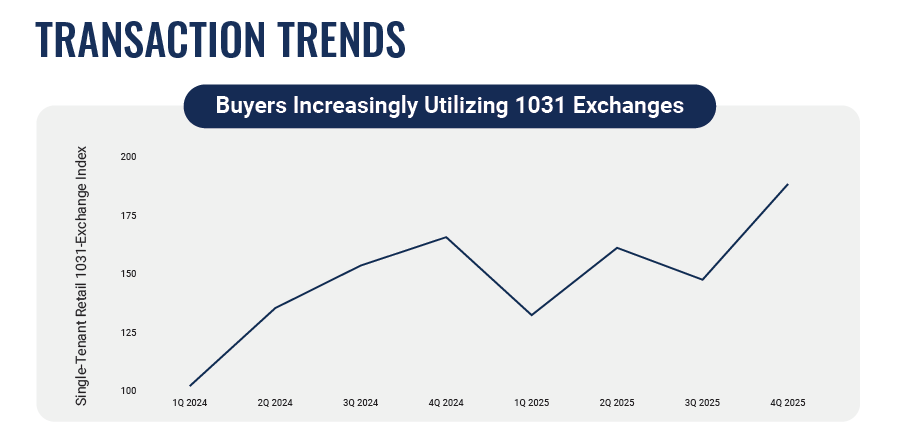
The strongest signal for apartment owners considering this strategy is the increase in 1031 participation.
Marcus & Millichap’s 2026 Single-Tenant Net Lease Retail Report shows 1031 exchange activity in the sector rising through 2025 and reaching its highest level since before 2024 in the fourth quarter. The report specifically identifies tax deferral and the ability to target particular retailer profiles as key attractions for investors. 2Q 2026 U.S. Single-Tenant Net-…
The Underwriting Changes When You Leave Apartments
An apartment investor is accustomed to evaluating:
Rents
Vacancy
Operating expenses
Unit condition
Renovation potential
Property management
Supply and demand
Net lease requires a different framework.
The questions increasingly become:
Who is the tenant?
How strong is the tenant’s credit?
How much lease term remains?
Are there contractual rent increases?
Who is responsible for property expenses?
How replaceable is the tenant?
What is the underlying real estate worth without the lease?
That last question is particularly important.
A lease can create attractive income, but the investor still owns the real estate underneath it.
Lease Term Has Real Value
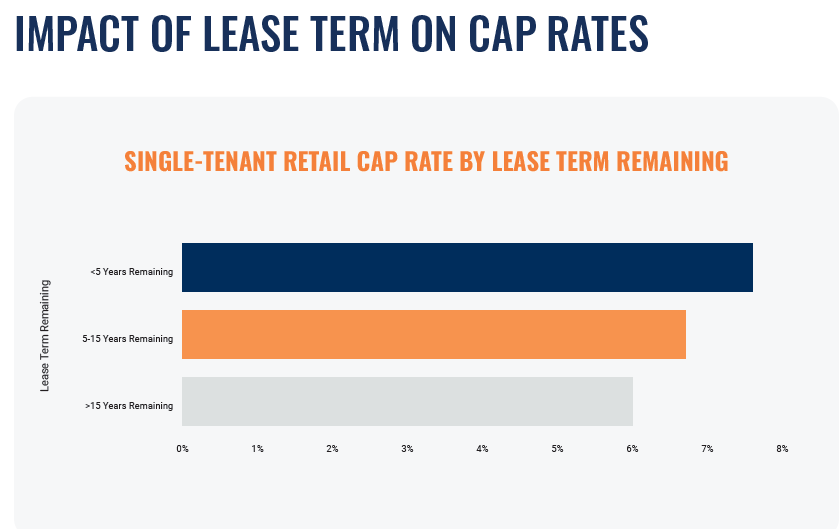
The report provides a useful illustration of how investors price lease duration.
Average cap rates were approximately:
7.6 percent for properties with less than five years remaining
6.7 percent for properties with five to 15 years remaining
6.0 percent for properties with more than 15 years remaining
The lower cap rates on longer leases reflect the value investors place on greater cash-flow certainty. 2Q 2026 U.S. Single-Tenant Net-…
This is a useful adjustment for apartment investors.
In multifamily, a shorter lease can actually be valuable because rents can reset frequently.
In net lease, a long contractual term with a strong tenant can reduce uncertainty and command a pricing premium.
Tenant Credit Matters
Tenant quality can also materially affect pricing.
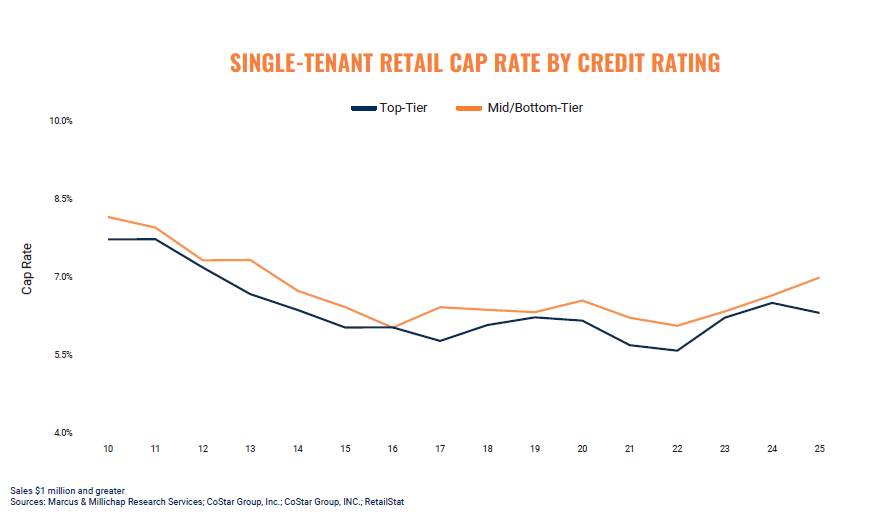
Marcus & Millichap research found that the market placed significant emphasis on top-tier credit tenants in 2025. While net-lease cap rates generally moved higher after 2022, the mean cap rate for top-tier tenants declined in 2025 even as the broader market remained at higher yields. 2Q 2026 U.S. Single-Tenant Net-…
That means two properties with identical rent and lease duration can have very different values depending on who is obligated to make the payments.
Apartment owners are accustomed to diversified tenant risk across many units.
Single-tenant ownership concentrates that risk into one lease.
That makes tenant underwriting especially important.
Do Not Buy the Cap Rate
This may be the most important principle for an apartment owner entering net lease for the first time.
A higher cap rate is not automatically a better investment.
It may be compensation for:
A shorter lease
Weaker tenant credit
Limited rent growth
Poorer real estate
Higher rollover risk
Specialized improvements that are difficult to reuse
The report shows shorter-lease assets trading at meaningfully higher cap rates because investors require compensation for reduced certainty around future cash flow. 2Q 2026 U.S. Single-Tenant Net-…
A 7.5 percent cap rate with significant rollover risk may be substantially less attractive than a 6 percent cap rate supported by strong credit, long duration and high-quality real estate.
The yield needs to be understood in the context of the risk.
Compare the Return to the Risk-Free Rate
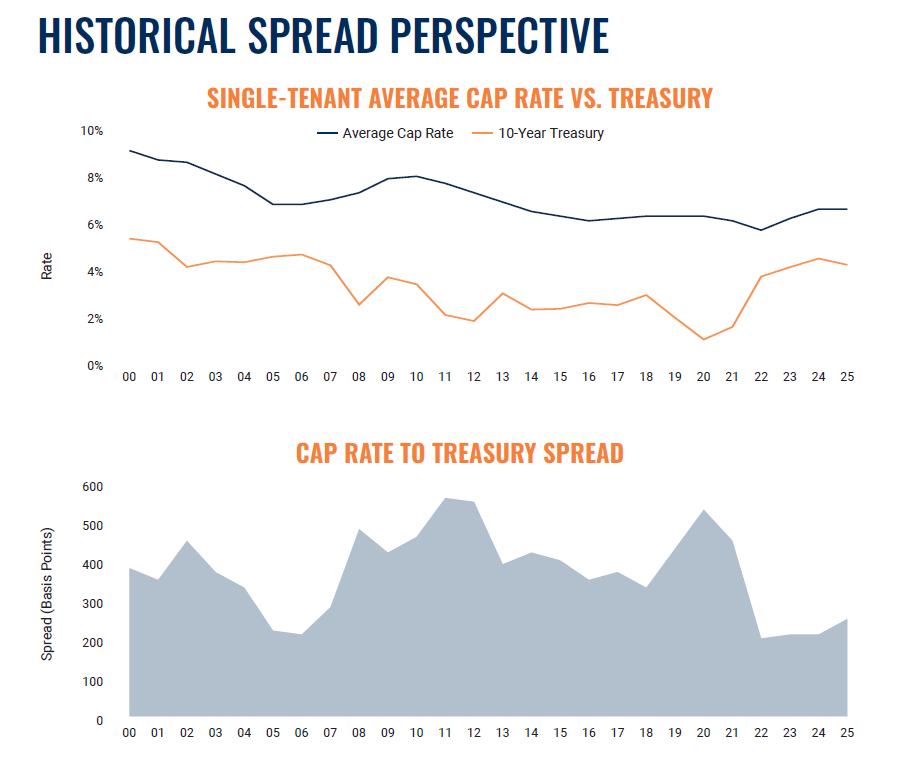
Another useful metric is the spread between net-lease cap rates and U.S. Treasury yields.
At year-end 2025, the average spread between single-tenant net-lease retail cap rates and the 10-Year Treasury was approximately 250 basis points.
Since 2000, the historical average spread has been approximately 370 basis points. 2Q 2026 U.S. Single-Tenant Net-…
The question is not simply:
Is a 6.5 percent cap rate attractive?
A better question is:
How much additional return am I receiving over the risk-free rate, and is that enough compensation for the tenant, lease and real-estate risk I am assuming?
Apartments and Net Lease Solve Different Problems
Neither asset class is inherently better.
They serve different investment objectives.
An apartment investor may prefer:
Greater control over operations
More opportunities to increase NOI
Frequent rent resets
Diversification across many tenants
Greater value-add potential
A net-lease investor may prioritize:
More predictable contractual income
Lower management intensity
Longer lease duration
Fewer operating responsibilities
Simpler portfolio oversight
The right choice depends on what the investor is trying to accomplish after the sale.
Questions to Ask Before Identifying Replacement Property
Before an apartment owner begins looking at replacement assets, I would want clear answers to a few questions:
How much income does the replacement property need to generate?
How important is management simplicity?
How much tenant concentration risk is acceptable?
How long should the lease run?
Is investment-grade credit important?
Does the investor want contractual rent growth?
How important is residual real-estate value?
What level of leverage is appropriate?
Is the goal income preservation, growth, estate planning or portfolio simplification?
The 1031 timeline can move quickly.
Those decisions are much easier to make before the relinquished property closes than during the identification period.
The Investment Takeaway
For an apartment owner considering a sale, a 1031 exchange does not necessarily mean buying another apartment building.
Single-tenant net lease can provide a very different ownership experience, with the potential for more predictable income and less operating responsibility.
But the simplicity of the operating model does not eliminate investment risk.
It changes where the risk sits.
Instead of focusing primarily on rents, vacancy and operating expenses, the investor must understand tenant credit, lease duration, contractual rent growth, residual real-estate value and the return being earned relative to alternative investments.
For the right investor, that trade-off can make sense.
The key is choosing the replacement strategy first — and the property second.
This commentary is provided for general market information only and is not tax, legal or investment advice. Investors should consult qualified tax and legal professionals regarding their individual 1031 exchange requirements.
Planning a 1031 Exchange?
The strongest replacement-property strategy usually begins before the apartment sale closes.
We can help evaluate the disposition, exchange timeline and investment characteristics that should guide your next acquisition.